

It’s 4:50 on a Tuesday. Practice is at 6:00, which means the car leaves at 5:40, which means dinner happens at 5:30 or it’s going to cost half the vacation fund to zip through a drive-thru. In the fridge: most of a rotisserie chicken that’s already been picked over once, a bag of spinach with maybe two good days left, a half a block of cheddar, eggs, flour tortillas. In the pantry, the usual: rice, a can of black beans, an onion, salsa, and the standing collection of condiments.
I know how to cook. I LOVE cooking. That’s never been the problem. The problem is that by 4:50 I’ve already made a day’s worth of decisions for multiple people, and this one has to account for who’s eating, who’s leaving, what got eaten yesterday, and what’s about to turn. So I ran an experiment I’ve been thinking about for a while.
The test
So I created a single prompt. But I used that exact same prompt in two different places.
Round one went into a brand-new chat. It had none of my previous meal-planning history. I didn’t add any context. It was the AI equivalent of a stranger at the door.
Round two went into my Dinner Project, the one I set up after writing the Project guide. It already knows how many of us there are, who won’t eat what, that Tuesdays and Thursdays are tight, and what’s almost always in the pantry. I didn’t touch it before the test. I just opened it and pasted in my prompt.
Here’s the prompt, if you want to run this yourself tonight:
> It’s 4:50. We have to be in the car by 5:40 and I want everyone eating by 5:30. Here’s what I’ve got: most of a rotisserie chicken, a bag of spinach, a block of cheddar, eggs, tortillas, rice, a can of black beans, an onion, salsa. Give me one dinner, not three. Include a timeline with actual clock times, starting now. Tell me if anything you’d need isn’t on my list.
I’m using Claude, free plan, same model for both rounds.
Round one: the blank chat
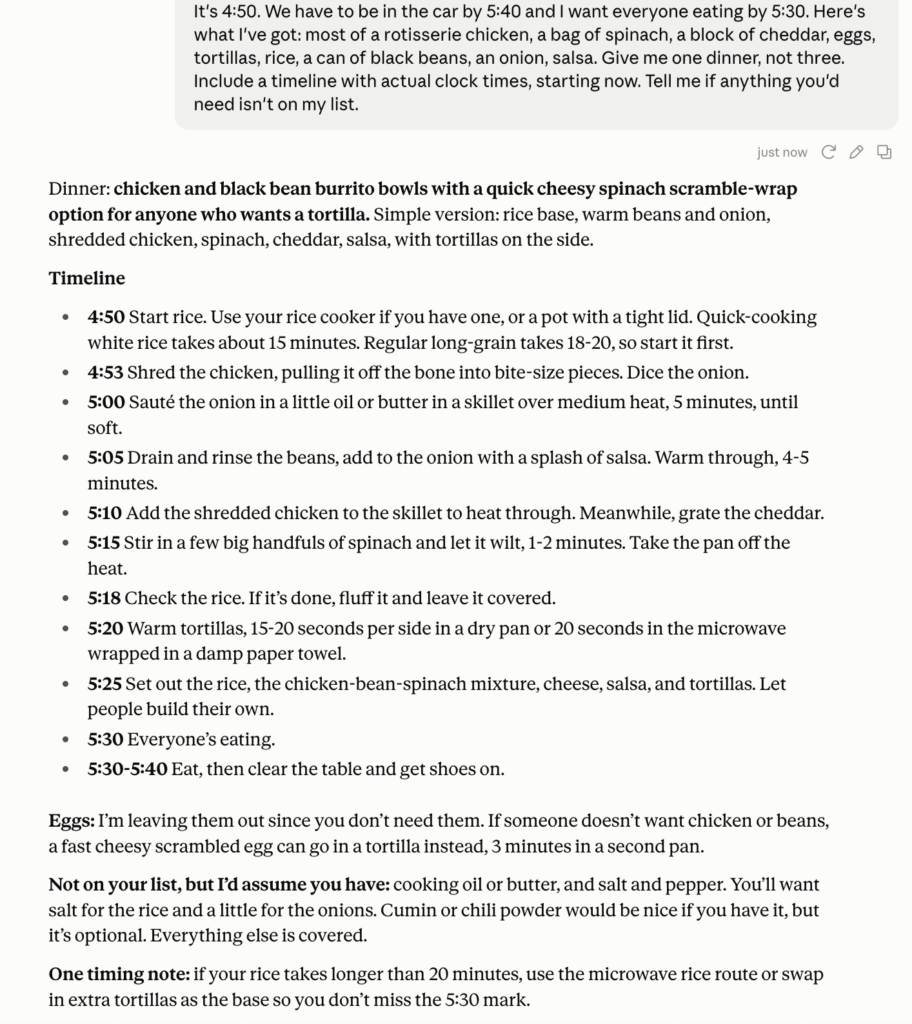
This is a pretty good response. All in all, the recipe sounds pretty tasty. It doesn’t require any ingredients that I didn’t mention or that it couldn’t reasonably assume that I had. That timeline is helpful but it might be pushing reality just a bit. But it’s a good option.
But notice a couple of things: 1) It doesn’t give me any amounts. I’m just cooking rice, chicken, tortillas. It doesn’t give me amounts because it has no idea how many people I’m cooking for. 2) It’s not tailoring this to any preferences or dietary restrictions. It does give me the scrambled egg option in case there’s an issue with the recipe it suggested. But it doesn’t know, so it’s generally covering its bases.
None of that is the tool being bad. It’s the tool being uninformed. I asked a stranger and got a stranger’s answer.
Round two: inside the Project
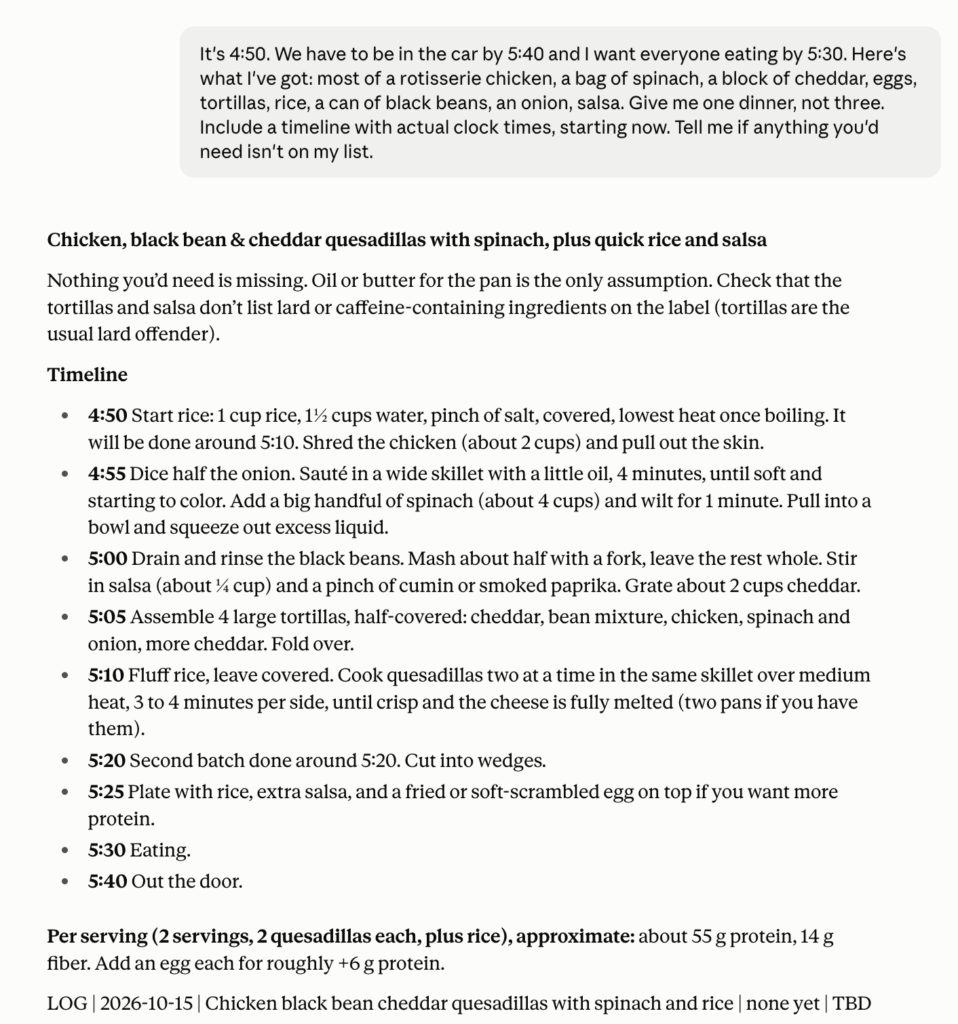
So I get a different recipe but it’s pretty close to the same idea as the first. But notice where it goes the extra mile. I get specific amounts of my ingredients. A cup of rice. Four tortillas.
I also get a plan that is a little bit more functional for this kind of rushed night. I’m getting two batches of quesadillas. I can start doling those out as they get done to help make that 10-minute eating window a bit more manageable. And notice that it reminds me to check for ingredients that are flagged in my project as being no-gos. Check for lard and caffeine in any of the processed products I’m using for the recipe.
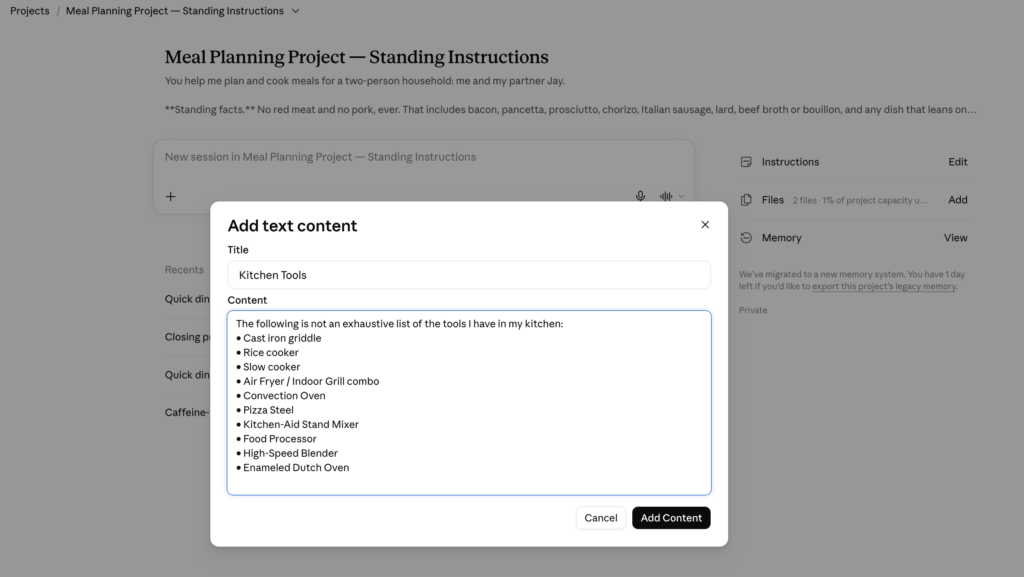
And then upon reviewing the both of these, I also realized an opportunity to make my project knowledge better. If I add the tools I have at my disposal into my project, then it can be even more specific. I can mention my rice cooker and my large griddle so in the future, it knows that I can use those tools and it can adjust timing accordingly.
To do that, I simply when to the Project page, clicked on “Add” in the “Files” section on the right. I selected “Add Text Content” and added a list of what I could remember off the top of my head. Now future recipes coming from this project can tailor the instructions to what is actually in my kitchen.
And that last, mystery line at the end of the response? Remember this from our project instructions?
**Logging.** Any time I settle on something to actually cook, end your message with a single line in exactly this format, without being asked and without commentary around it:
`LOG | YYYY-MM-DD | dish | what I changed from your version | verdict`
Use TBD for the verdict unless I’ve told you how it went. If I come back later in the chat and say it was good or bad, reissue the whole line with the real verdict so the latest one is correct. Verdicts are: Repeat, Fix, Never, TBD. Keep the “what I changed” field to a few words. One line, every time, no exceptions — this is how the log gets built, and a chat that ends without one is a lost entry.
That gave us the output so we can tell the project later what worked and didn’t for this recipe, and it can feed (no pun intended) the information back into the project to improve the outcomes more and more over time.
The scorecard
Three questions, because those are the only three that matter at 4:50.

Why this is the whole story
Nearly everything written about getting better answers from AI is about phrasing. Add a role, say “step by step,” use a magic sentence somebody posted. Some of it moves the needle a little.
Context moves it a lot. A plain request sent into a workspace that already knows your constraints beats a beautifully engineered prompt sent into an empty window, and it isn’t close. The tool stopped guessing at my situation because I’d handed it my situation, once, in about ten minutes, two weeks ago. And in the future, it will be even better because this round unearthed
That’s the part that doesn’t show up in the screenshots people share online. They’re not using a better prompt than you. They’re twenty messages into a workspace that already knows what they’re working on.
Do this tonight
1. If you don’t have a Project yet, set one up. Ten minutes, free on all three tools.
2. Paste in the standing instructions below, edited for your house.
3. Next time it’s 4:50 and you’re staring into the fridge, run the prompt above inside it. Then tell me what came back. I read every reply.
Here’s the standing text I use. Steal it.
> Use this whenever we talk about food. [Number] of us eat dinner. [Dietary notes: who won’t eat what, allergies, anything medical.] Weeknights are 30 to 40 minutes, and [Tuesdays and Thursdays] are tight because we’re in the car by [5:40]. We shop once a week and almost always have eggs, rice, pasta, tortillas, canned beans and tomatoes, frozen chicken, and too many condiments. When I ask about dinner, give me one answer unless I ask for options, include clock times, and never assume an ingredient I didn’t list.
Subscribe so Tuesday’s article finds you. One email a week from me, with the thing that didn’t make it into the post.
