

I want to start by telling you something that may make me sound like a bad environmentalist: the bottle-of-water number never felt right to me.
You’ve seen it. “Every time you ask ChatGPT a question, it drinks a bottle of water.” It showed up in my feeds last year and it has never really left, and the thing that made me suspicious wasn’t the number itself so much as how hard people were pushing it. Thirty years of journalism and business analysis have taught me that when a statistic gets repeated that fervently, by that many people who clearly haven’t read the source, there’s usually more going on behind it than the statistic. (The slightly paranoid part of me even wondered, for about a day, whether somebody had an interest in keeping the rest of us nervous about these tools while they got good at them. I’m not saying that’s what happened. I’m saying that’s how loud it got.)
So I did what I do, which is go find the paper. And what I found is that there isn’t one question here. There are three, and they have genuinely different answers, and the reason the conversation about AI and the environment feels so unsatisfying is that everybody keeps mashing them together. Let me take them one at a time, and then I’ll tell you the one thing you can actually do about any of it.
Is my recipe question using up water?
Not in any way that should change how you live. This is the one where the headlines are furthest from the paper.
The bottle-of-water claim traces back to a 2023 study from UC Riverside with the wonderful title “Making AI Less Thirsty.” What the researchers actually wrote is that the model behind the original ChatGPT used roughly a 500-milliliter bottle of water for every 10 to 50 medium-length answers, depending on where the data center was and what time of year it was running. Early press coverage turned that into “a bottle for every 20 to 50 questions,” which was already a simplification, and then the internet did what the internet does and dropped the denominator entirely. By the time it reached your feed, a bottle per fifty answers had become a bottle per answer.
It’s worth knowing what that study was counting, too, because it’s the honest way to count. The Riverside team included not just the water that cools the computers but the water used back at the power plant to make the electricity. That’s the number you want, and it’s bigger than the one the companies would prefer you look at.
Which brings me to Google. Last year Google published its own measurement, and it said a typical Gemini text prompt uses about 0.26 milliliters of water, which is roughly five drops. I believe that number as far as it goes. The catch is that it only counts water used at the data center itself, not the power plant, so it’s answering a narrower question than the one you’re asking. When independent researchers add the power plant back in, a single question lands somewhere between one and five milliliters. Call it a teaspoon at the high end.
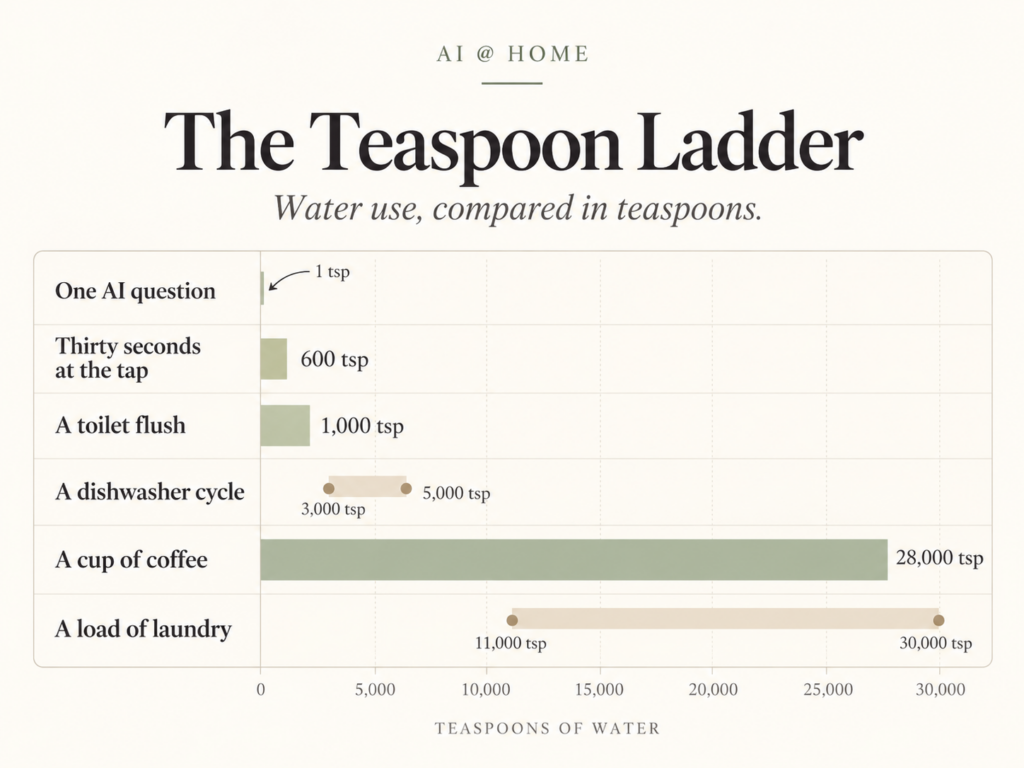
I’m a person who makes spreadsheets for fun, so of course I needed something to compare that to. And the comparison only works if everything is in the same units. So here it is in teaspoons, since a teaspoon is about five milliliters and that’s the high end for one question. A gallon is 768 teaspoons. When you stand at the bathroom sink for thirty seconds waiting for the water to run warm, the faucet sends about three quarters of a gallon down the drain, which is around 600 teaspoons, or 600 recipe questions. One flush of a modern toilet is 1.3 to 1.6 gallons, call it a thousand questions. A dishwasher cycle is 4 to 6 gallons, so three to five thousand questions. A load of laundry is 15 to 40 gallons depending on how old your machine is, which is somewhere between 11,000 and 30,000 questions, or roughly every AI question you’d ask in several years of daily use. And the cup of coffee you drank while reading this took about 37 gallons to grow and process, which is roughly 28,000 questions, or close to a decade of asking what to do with the chicken every single night. Your recipe question does not belong on that list.
What about the town where the data center actually is?
This is the one where things aren’t quite as rosy. Concern here isn’t misplaced, and I’d be doing you a disservice to pretend otherwise.
A teaspoon per question spread across the country is nothing. A whole data center drawing from one town’s reservoir, every day, all day, is something else entirely. The Meta facility in Newton County, Georgia, outside Atlanta, uses about 10 percent of the county’s daily water consumption. That’s according to the county’s own water authority. The county’s supply is a reservoir that refills when it rains. Residents’ water rates are set to rise by a third over two years, and families near the site have reported wells going muddy or dry. Meta says it isn’t the cause, and the county’s water director has not sounded reassured. Nine more companies have applied to build there, some asking for more water per day than the entire county uses now.
You’ll sometimes hear this answered with a golf course comparison, and the comparison is fair as far as it goes. A typical 18-hole course irrigates with something like 300,000 gallons a day, a course in the desert Southwest can go through close to a million, and a data center like Meta’s is estimated at about half a million. So a data center does drink about like a golf course. The difference is where the water goes afterward. Most of what lands on a fairway soaks back into the ground, while most of what goes through a cooling tower evaporates and leaves town. The comparison tells you the scale, and it’s useful for that. But it just doesn’t tell you the whole story.
So if your question is “should my town be paying attention when a data center wants to build next to the reservoir?” the answer is yes, and go to the meeting. That’s a siting question, a zoning question, a who-pays-for-the-water-main question, and it’s completely legitimate. It’s just a different question from whether you should ask for a dinner idea, and I think the two have been doing each other a disservice by sharing a headline.
Is this showing up on my electric bill?
Some of it is. Not all of it, and not in the way the scary version suggests. Let me walk through what’s actually happening to the bill.
Residential electricity prices in the U.S. rose about 13 percent between 2022 and 2025, which is faster than inflation over the same stretch. Last year utilities asked their regulators for a record 31 billion dollars in rate increases, and they’ve filed for another 18 billion or so in the first half of this year. Those numbers are real, and they’re the reason I don’t want to hand you a tidy “nothing to see here.”
But when I read the people whose actual job is to figure out why bills go up, the picture is a lot more ordinary than “AI did it.” Lawrence Berkeley National Laboratory does an annual review of exactly this, state by state, and their list of what pushed prices up last year reads like a list of everything that’s been going on in the world. Natural gas got more expensive after hitting a low in 2024, and gas sets the wholesale price of power in most of the country. Utilities are replacing wires and poles that are fifty years old, at today’s prices, and hardening them against storms. Florida and Maine customers are paying surcharges for hurricane and storm cleanup. Some utilities are building new plants. And yes, in a handful of regions, demand from data centers is a real part of it. The lab also points out something I found genuinely interesting: Over the longer run, more demand on the grid has historically pushed prices down, not up, because the cost of all those wires gets spread over more customers. Whether that holds this time depends on how fast the buildout happens and who the regulators decide should pay for it. That question is being settled right now, mostly without us in the room.
My home state of Illinois is one of the places where the data center piece is real and specific, so let’s take a look at that. Northern Illinois gets its power through a regional grid operator called PJM, which runs an annual auction to make sure there are enough power plants available on the hottest days, and we all pay for the result. The last two auctions cleared at record prices. The grid’s own independent market monitor said data center demand was the main reason, and the Citizens Utility Board here estimates that the auction alone is adding roughly 12 percent to a typical ComEd bill this year. The Illinois Commerce Commission has opened an investigation and tightened the rules for data centers asking to connect. I’ve read the industry’s line that there’s “no demonstrable price increase” from any of this, and I’m not going to repeat it in my own voice, because the people watching the bills in my state aren’t repeating it either.
So here’s where I land, and like nearly everything in the world, it’s not a black-and-white answer. Your recipe question is a rounding error. The buildout that makes the recipe question possible is not, and part of the bill for it is landing on households that have never typed anything into a chatbot. Both of those things are true at the same time, and I don’t think you need to feel bad about the first one to think the second one deserves a regulator’s attention.
The part about the choices we already make
As with any topic that causes controversy, when you start peeling the onion, you discover more and more.
Those data centers that are the lightning rod for so many conversations right now aren’t an AI thing. They’re an internet thing. The same buildings that answer your dinner question are holding your photos, backing up every phone in your house, streaming the show you fell asleep to last night, and carrying the video call with your mother. By the industry’s own research group’s estimate, AI is somewhere between 15 and 25 percent of what U.S. data centers do. The rest is everything else we’ve moved online over the last fifteen years without a second thought. Nobody ever posted a bottle-of-water graphic about Netflix.
And for scale, data centers altogether use about 4.4 percent of the electricity in this country. Residential air conditioning uses more. All of AI, everywhere in the world, every chatbot and image generator and the training runs behind them, used around half a percent of the world’s electricity last year. That’s not nothing, and it’s growing fast, but it’s also not the monster in the infographic.
I’m not saying any of that to let the AI companies off the hook. I’m saying we make a hundred choices a day that run on this same infrastructure, and we make them without guilt because nobody handed us a scary number. The one question you asked about leftover chicken is roughly five to ten seconds of streaming video, by the companies’ own math. If the thermostat debate is back at your house this week, as it is at mine, that debate is about more electricity than every AI question you’ll ask this year. Nothing here is black and white. It’s a set of trade-offs, like everything else that runs a household, and you’re allowed to make them like an adult rather than a penitent.
The one choice that’s actually yours
The reality is you can’t fix a capacity auction from your kitchen. But there is one thing you can do that measurably changes how much your own questions cost, and almost nobody explains it.
Most of the AI tools now come in two speeds. There’s the fast model, which answers a normal question in a second or two, and there’s the “thinking” or “reasoning” model, which works through a problem step by step before it answers you. The reasoning models are remarkable for genuinely hard problems. They are also much more expensive to run. In benchmark testing published last December, models with reasoning switched on drew somewhere between 30 and 100 times more energy per answer than the same models with it off. Those tests used open models rather than the commercial ones, so hold the exact multiple loosely, but the direction isn’t in doubt.
The practical version is this. Use the fast one by default. The recipe, the email draft, the “how do I politely say no to the bake sale,” all of that is fast-model work, and the fast model is a teaspoon of water and a few seconds of a television. Save the thinking model for when you actually need something thought through, the same way you’d save the oven for things that need the oven and use the microwave for the rest. In ChatGPT that’s the model picker at the top of the chat, in Claude it’s the “extended thinking” toggle, and in Gemini it’s the “Thinking” option in the same spot.
That’s the whole lever. Ask the fast one most of the time. Go to the meeting if there’s a meeting in your town. And please, go ahead and ask what to do with the chicken. It was never the chicken.
