

It’s 5:15. You’re standing in front of an open refrigerator that contains, by any reasonable measure, food. There’s chicken in there. There’s half a bag of spinach doing its best. There are four condiments you bought for one recipe in 2023.
And you have absolutely no idea what dinner is.
This is not a cooking problem. If someone handed you a recipe right now, you’d make it. You know how to cook. The problem is that you’ve made roughly forty decisions today already, and this one has to account for who’s home, who’s leaving at six, what got eaten yesterday, and what’s about to go bad. It’s just… too much.
That’s the part AI is genuinely good at. Not the cooking, of course. The ideas and help with the decision. .
What most people get wrong
Here’s what people do the first time, and then they conclude AI isn’t that useful:
What should I make for dinner?
You’ll get an answer. It’ll be a perfectly nice recipe for chicken piccata. It will also require capers, and you do not have capers, and now you’re annoyed and you’ve closed the tab.
The problem isn’t the tool. It’s that you gave it nothing to work with. You asked a stranger to guess.
Everything below is built on one idea: stop asking for a recipe and start describing your actual situation. The more real constraints you hand to it, the less generic the answer gets. (Quick note: I’m using Claude free version on here. Each is its own conversation and I’m using the most recent Sonnet model.)
Prompt 1: The fridge reality check
This is the one to use when you have ingredients and no plan. Open your fridge, actually look, and type what you see. Don’t organize it. Don’t make it a nice list.
I have chicken thighs, half a bag of spinach, eggs, a lemon, rice, and most of a block of parmesan. Standard pantry stuff like oil, garlic, salt, and spices.
I have 40 minutes. Two adults eating.
Give me three options, ranked from least effort to most. For each one, tell me exactly what I’d have to go buy. Do not suggest anything requiring an ingredient I didn’t list unless it’s something you’d expect in any kitchen.
That last line is the whole trick. Without it, you’ll get a recipe that quietly assumes you have fish sauce. With it, you get options you can actually execute tonight.
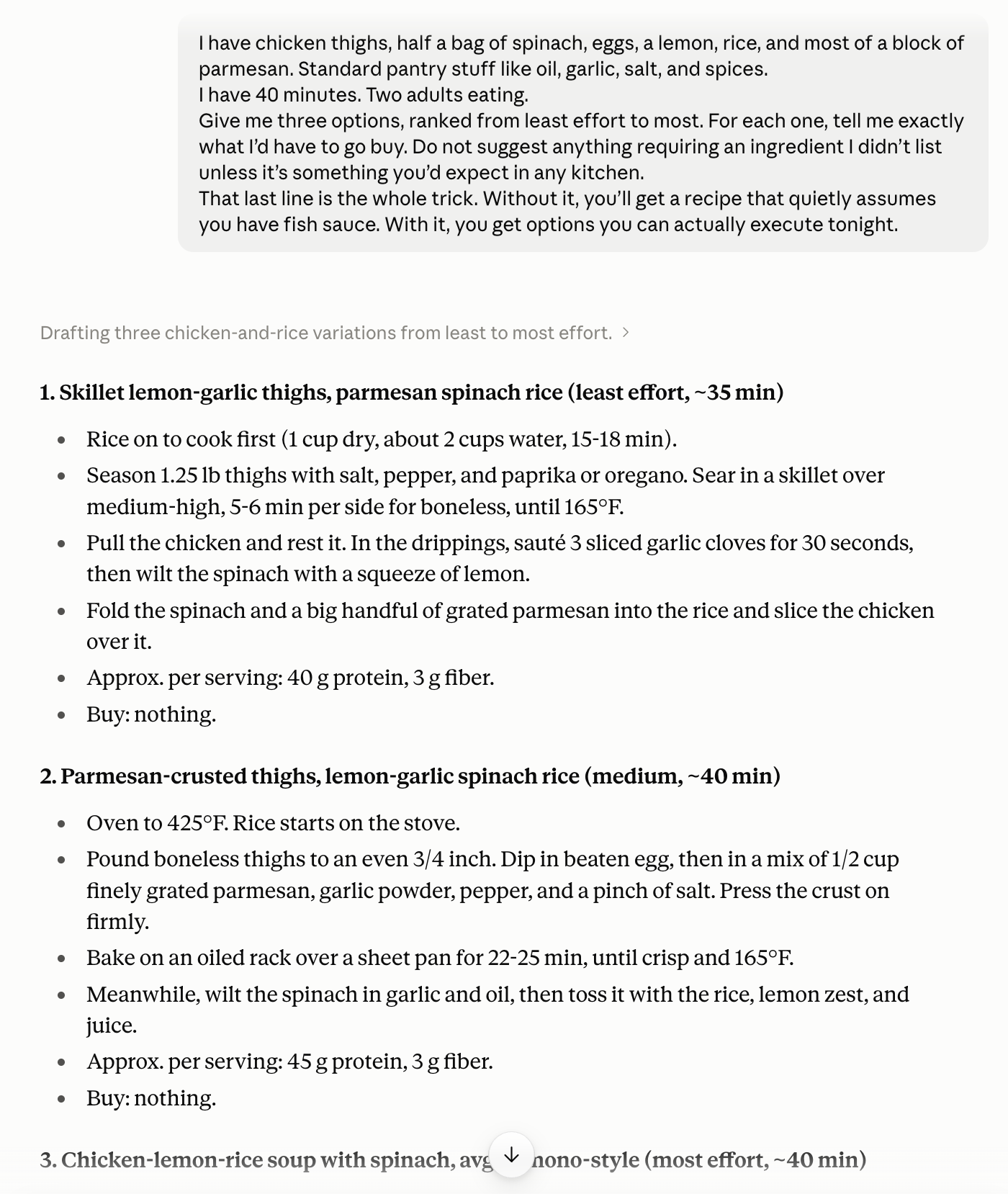
Notice what came back. Not an instruction. A shortlist. You’re still choosing. You’re still the one who knows that nobody in this house will eat that fried rice.
Prompt 2: The 5:30 version
Some nights you don’t need three options. You need someone to decide.
It’s 5:30. I have ground beef, tortillas, an onion, and a can of black beans. I have zero energy. I do not want to chop anything or use more than one pan.
Give me two options and then pick one for me. Tell me why you picked it.
Two things are revealing to the AI your most important elements to consider.
The first is “zero energy.” That’s an important constraint and it changes the answer completely. Most people won’t type it because it feels like an admission of defeat. Type it anyway. It’s the most direct way to get the answer you need on a weeknight.
The second is “pick one for me.” Decision fatigue is your actual enemy on a night like this, and handing back three choices doesn’t solve it. Just ask for a decision. You can always overrule it, and honestly, half the time seeing the wrong pick helps you figure out what you actually wanted.
Prompt 3: The one that compounds
The first two prompts solve your issue tonight. This one helps you build a system that can work every night.
Instead of re-explaining your household every single time, you write it down once:
I’m going to give you standing context about my household. Use this whenever we talk about food.
Two adults. One of us doesn’t eat pork. Neither of us will touch mushrooms and we’ve made peace with that.
Weeknights: 30 to 40 minutes max, and Tuesdays and Thursdays are tight because we’re out the door by 6:30. Weekends are open.
We shop once a week. We almost always have eggs, rice, pasta, canned tomatoes, frozen chicken, and too many condiments.
What we’re bad at: using produce before it dies, and eating the same four dinners on rotation.
When I ask you about dinner, use all of this without me repeating it. Ask me what’s in the fridge if you need to know.
Paste that at the top of a conversation and the rest of that conversation gets noticeably better. Every answer already accounts for Thursday being tight and nobody eating mushrooms.
But you’d have to paste it again tomorrow. And the day after.
There’s a way to make it stick permanently, so that every food conversation you ever have starts from your actual life instead of from scratch. ChatGPT calls it Projects, Claude calls it Projects, and Gemini calls them Gems.
Here’s the part people don’t realize: you do not have to pay for this. ChatGPT Projects are available on every plan including free. Gemini Gems are free to build. Claude gives free accounts up to five Projects, which is more than enough when one of them is your / your family’s dietary preferences.
It takes about ten minutes to set up and it’s the single biggest jump in usefulness available to you.
That’s its own guide: What’s a Project, and why you want one →
Go set one up. Then come back and run Prompt 1 inside it. The difference is not subtle.
When the answer is bad
It will be, sometimes. Here’s what actually goes wrong and what to do about it.
It invents a cook time. AI is confidently wrong about how long things take, especially anything braised or roasted. Trust your own judgment on timing over whatever number it gives you. If you don’t have that judgment yet, check the number somewhere else.
It gives you a food blog answer. Long, fussy, eleven ingredients. Say so: “Too complicated. Same idea, half the steps.” It’ll fix it immediately. You just have to tell it.
It ignored something you said. This happens more than it should. Point at it directly: “You gave me something that takes an hour. I said 40 minutes.” Correcting mid-conversation works better than starting over.
The thing to internalize is that a first answer is a draft, not a verdict. The people getting good results from these tools aren’t writing magic prompts. They’re just willing to say “no, not that” and go again.
One boundary worth keeping
You don’t need to hand over your family to get help with dinner.
Say “one of us has a nut allergy,” not your kid’s name, age, and school. Say “we’re on a tight grocery budget this month,” not your income. You get the same quality of answer either way, and there’s no reason to put more into a chat box than the problem requires.
More on where those lines are in AI and Data Security.
The part that’s still yours
You’re the one who knows that the chicken thing was a hit last month. You’re the one who knows Thursday is going to be a disaster and it should be breakfast for dinner. You’re the one who tastes it and decides it needs more lemon.
None of that is going anywhere. What’s going away is the twenty minutes of standing in front of the fridge running scenarios, which was never the good part of cooking anyway.
Start with the fridge reality check tonight. Type what you actually have, tell it how much time you’ve got, and see what comes back.
Then tell me how it went. I want to know which parts of this hold up for you in your kitchen, with your constraints. Subscribe and hit reply to let me know, or send me a note if you’d rather.
