

You find the recipe. It looks good, it looks doable, everyone might actually eat it. Then you hit line four and it calls for buttermilk, and one of you is dairy free, and now you’re back to searching.
So you look for a dairy free version. What you find is a different recipe entirely, with worse reviews, written by someone whose priorities are not your priorities.
This is one of the places AI earns its keep, because the useful question was never “find me another recipe.” It was “what is the buttermilk actually doing here, and what else could do that job.”
Why the obvious prompt gives you a bad answer
Type “make this gluten free” and you’ll usually get a one-for-one swap. Replace the flour with gluten free flour. Done.
Sometimes that works. Often it doesn’t, because ingredients do more than one job. Flour is structure and it’s also thickening. Eggs are binding and leavening and moisture. Butter is fat and flavor and, in baking, air. Swap one thing for another that only covers half the job and you get a sad, dense, weeping result and no explanation of why.
The fix is to ask about function first. When you make the tool explain what the ingredient is doing before it suggests a replacement, the quality of the substitution changes immediately.
The prompt
Paste your recipe, then this:
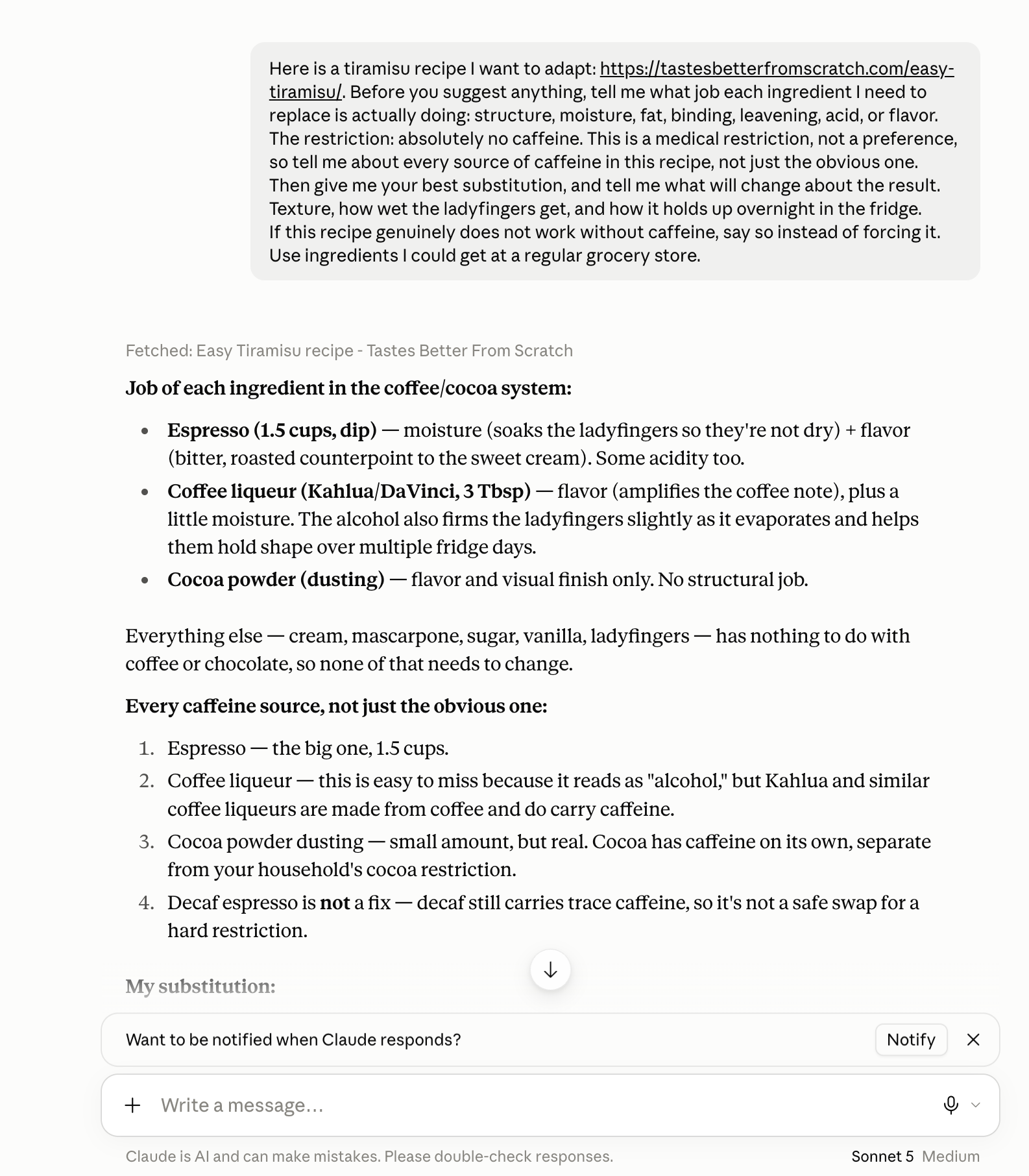
Here is a recipe I want to adapt. Before you suggest anything, tell me what job each ingredient I need to replace is actually doing: structure, moisture, fat, binding, leavening, acid, or flavor.
The restriction: [dairy free / gluten free / no eggs / low sodium / no added sugar / whatever it is].
Then give me your best substitution, and tell me what will change about the result. Texture, cook time, how it holds up the next day.
If this recipe genuinely does not work with that restriction, say so instead of forcing it. I would rather know now.
Use ingredients I could get at a regular grocery store. No specialty flours I would have to order.
That last two lines do a lot of work. Without them you’ll get a confident adaptation of something that was never going to survive the change, plus a shopping list with three items you have to order online.
The part where I need you to be careful
Everything above is for preference and comfort restrictions. Dairy free because it upsets your stomach. Lower sodium because your doctor asked. Vegetarian because that’s how you eat.
For a serious allergy, do not use AI as your safety check.
I want to be specific about why, because “be careful” is useless advice.
These tools will tell you confidently that an ingredient is safe when it isn’t. They don’t know what brand is in your pantry. They don’t know that the formulation changed last year. They have no idea whether the facility also processes peanuts. And they will not hedge, because hedging is not what they were built to do. You will get a clean, reassuring, wrong answer in the same tone as a right one.
So use it for ideas. Then read the actual label on the actual package in your actual hand, every single time, the way you already do. The tool narrows your options. It does not clear them.
If someone in your house has an allergy that ends in an Epi-pen, that rule is not negotiable.
When the answer is bad
It swapped one thing and ignored the knock-on effects. Ask directly: “You replaced the eggs. What happens to the rise?”
It gave you a whole different recipe. Push back. “I want this recipe adapted, not a substitute recipe. Keep the method.”
It promised the result would be identical. It won’t be. A good answer tells you what you’re giving up. Ask for it: “What will actually be different about this?”
It suggested something you can’t have. Happens more than you’d hope, especially with multiple restrictions stacked. Point at it plainly and it will correct.
Set it up once
If you’re adapting recipes regularly, you’re going to get tired of retyping your household’s restrictions. Put them in a Project instead, once, and every conversation starts from there. That’s covered in What’s a Project, and why you want one.
Write the restriction, not the person. “One nut allergy, serious” is all it needs. Names, ages, and diagnoses don’t improve the answer, and there’s no reason to leave them sitting in a file somewhere. More on that in AI and Data Security.
Already have a food Project?
Don’t start a new one for this. Add four lines to the instructions you already have and every future recipe conversation gets better on its own.
Mark the severity of each restriction. Not just what it is, but what kind. Try: “Nut allergy is medical and serious. Dairy is a comfort thing, small amounts are fine. No mushrooms is a preference.” The tool treats those three identically unless you tell it not to, and they are not identical.
Make the function question standing. Add: “When I ask you to adapt a recipe, always tell me what job the ingredient is doing before you suggest a replacement.” Now you never have to type the long prompt again.
Ask it to flag its own uncertainty. Add: “If you are not certain an ingredient or product is safe for our restrictions, say so plainly and tell me to check the label.” This does not make it reliable on allergies. Nothing does. It does make the hedging visible instead of absent.
Keep a file of what worked. One running document: the recipe, the swap, and whether anyone ate it. Upload it to the Project and update it every month or so. This is the part that compounds. Six months in, it stops guessing at your kitchen and starts remembering it.
Try it on the one that got away
Pick the recipe you gave up on. Paste it in with the prompt above and see what comes back.
Then tell me what you’re adapting. The restriction combinations people are working around are more interesting than any recipe, and I’d rather write about the real ones. Subscribe and hit reply to tell me what worked for you, or send me a note if you’d rather!
