

Someone gave you a number. Maybe a doctor, maybe a trainer, maybe an article you half remember. A hundred grams of protein. Thirty grams of fiber.
Then you looked at what you actually ate for lunch and did some rough math and came up with something like eighteen and four.
The gap feels enormous. It feels like a job. It also feels like a character problem, which it isn’t. It’s an information problem, and that’s a much better kind of problem to have.
First, about the number
Worth knowing where these come from, because the ground moved recently.
The 2025-2030 Dietary Guidelines, released in January 2026, raised the protein recommendation substantially, from the long-standing 0.8 grams per kilogram of body weight up to a range of 1.2 to 1.6. That is a large jump, and it has been openly contested by nutrition researchers who argue the evidence behind it came mostly from weight-management studies and doesn’t support a universal target for everyone.
Fiber went the other direction. It got comparatively little attention in the update, even though it’s the nutrient Americans most consistently fall short on. The recommendations sit somewhere around 25 to 38 grams a day depending on age and sex. The average adult eats about 15.
What that means for you: use the number your doctor gave you, for your body and your situation. If you got your number from a headline, treat it as a rough direction rather than a target. This is genuinely contested territory right now and anyone telling you otherwise is selling something.
One more thing before the useful part. If tracking food has been a difficult thing for you in the past, this particular approach is not neutral, and you’re allowed to skip it. There are other articles.
Why this is a machine job
The reason people fail at this isn’t discipline. It’s that you don’t know what’s in your food, what the size of a “serving” is, what the most efficient ways to get these macronutrients are. Figuring it out means looking up thirty separate items. It’s tedious at best. A drudgery more often than not. And looking things up more than once makes me want to scream.
But here’s what most people ask for, and why it doesn’t help:
Give me a high protein, high fiber meal plan.
You’ll get a plan. It will feature salmon and quinoa bowls and things you don’t eat, and it will require you to change everything at once, and you will follow it for four days.
The better move is backwards. Don’t ask what you should eat. Show it what you already eat and ask where the gap is.
The prompt
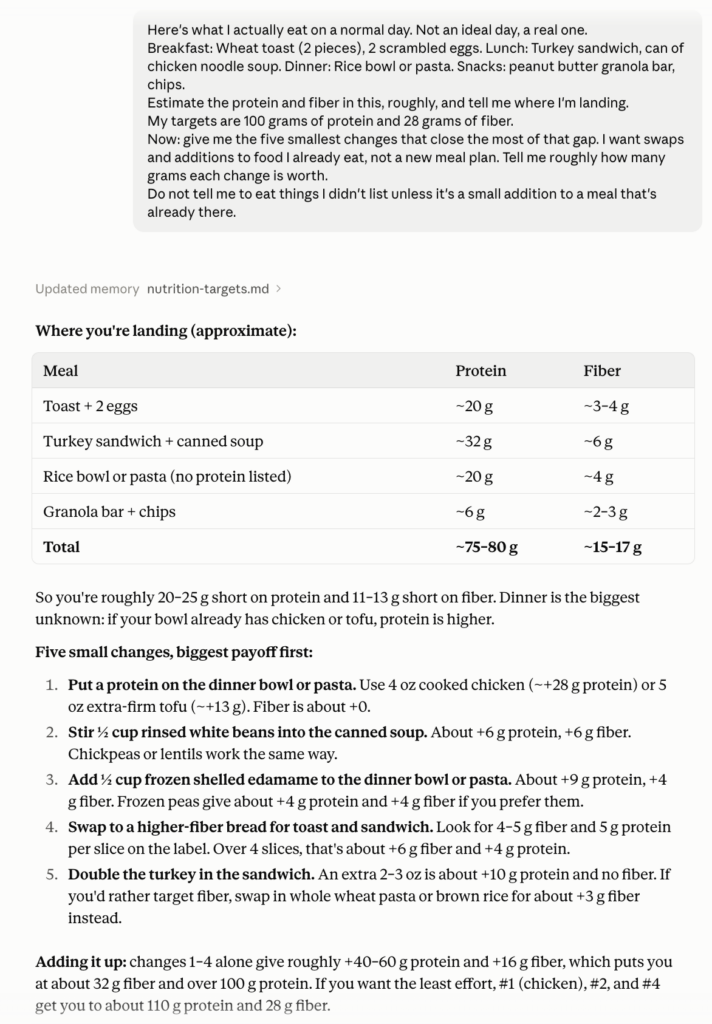
Here’s what I actually eat on a normal day. Not an ideal day, a real one.
Breakfast: [what you actually have] Lunch: [same] Dinner: [same] Snacks: [be honest]
Estimate the protein and fiber in this, roughly, and tell me where I’m landing.
My targets are [X] grams of protein and [Y] grams of fiber.
Now: give me the five smallest changes that close the most of that gap. I want swaps and additions to food I already eat, not a new meal plan. Tell me roughly how many grams each change is worth.
Do not tell me to eat things I didn’t list unless it’s a small addition to a meal that’s already there.
The phrase doing the heavy lifting is “smallest changes.” Left to its own devices it will rebuild your diet. What you want is the two or three swaps that move the number most, because those are the ones you’ll still be doing in March.
What comes back, usually
The answers cluster, and they’re less dramatic than you’d expect. Greek yogurt instead of regular. Beans added to something you were already making. Lentils in the soup. A different bread. Frozen edamame, which nobody thinks of. Cottage cheese, which has made a comeback (I admit to LOVING cottage cheese, and I’m frustrated the craze, among other things, has driven up its price).
The unglamorous truth is that five or six recurring items usually account for most of the gap, and beans do a startling amount of the work because they carry protein and fiber at the same time.
You’re not rebuilding anything. You’re upgrading the same lunch you were going to eat anyway.
Two cautions
The numbers are estimates. It will get some of them wrong, occasionally by a lot, especially on packaged food and restaurant portions. Use it for direction, not precision. If a number matters medically, check the label or ask your doctor.
Go slow on the fiber. Going from 12 grams to 30 in one day will make you deeply uncomfortable and you will be cursing your new plan rather than sticking to it. Add a few grams a week and drink more water.
Make it stick
If you’re going to do this for more than a week, put your targets and your actual eating patterns into a Project so you’re not retyping it every time. Setup takes ten minutes: What’s a Project, and why you want one.
And keep it general. Your targets and your typical meals are all it needs. Lab results, diagnoses, and medication lists don’t improve the answer and don’t belong in a chat window. in AI & Data Security: How to Keep Your Information Safe.
Already have a food Project?
This one folds into it. Four lines, and you never run the audit prompt manually again.
Put the targets in the instructions. “I’m aiming for roughly [X] grams of protein and [Y] grams of fiber a day.” That’s it. Not your weight, not your bloodwork, not why.
Make the estimate automatic. Add: “Whenever you suggest a meal, give me a rough protein and fiber estimate with it, and say that it’s approximate.” Now every dinner suggestion comes pre-checked and you stop doing math at 5:30.
Ban the meal plan. Add: “Never rebuild my week. Work from food I already eat and suggest the smallest change that helps.” This is the single line that determines whether you’re still doing this in March.
Keep a file of the swaps that stuck. A short running list: what you changed, roughly what it was worth, and whether you’re still doing it three weeks later. Upload it. The abandoned ones are more useful than the successful ones, because they teach it what you will not actually eat.
If you already built a dinner Project after the weeknight piece, this belongs in that one. Two food Projects will drift apart and give you contradictory advice.
Start with one real day
Not a good day. Yesterday, whatever it looked like.
Then tell me which swap surprised you. I’m collecting the ones that actually stick, and the honest answer so far seems to be beans. Subscribe and hit reply to tell me yours, or send me a note if you’d rather.
